What Is True of the Neoclassical Style of Art
The Neoclassical catamenia, Neoclassicism or Neo-Classicism, was a revival of Greek and Roman art and architecture in Europe. It occurred around the eye of the 1700s (18th Century) and continued during the 1800s (19thursday Century). Neoclassicism was not only a consequence of new discoveries from Greek and Roman art and compages, only it was too a revolt against the opulence of the Baroque and Rococo art movements that came before.
Table of Contents
- i An Introduction to Neoclassicism
- 1.1 The Renaissance vs. the Historic period of Enlightenment
- 1.2 The Influences and Development of Neoclassicism
- 1.3 The Key Characteristics of Neoclassical Art
- 2 Famous Neoclassical Artists
- 2.1 Neoclassical Painting
- ii.2 Neoclassical Sculpture
- 2.three Neoclassical Architecture
- 3 The Ever Continued Neoclassical
- 4 Oft Asked Questions
- 4.i What Is Neoclassicism?
- four.2 When Was the Neoclassical Period?
- four.3 What are the Main Characteristics of Neoclassicism?
- 4.iv What Influenced the Neoclassical Movement?
An Introduction to Neoclassicism
First, let us look at the term "Neoclassical", the prefix neo originates from Greek roots (due north é os), according to the Merriam-Webster Dictionary online it translates to "young, fresh, new". The give-and-take "classics" as well translates from the Latin word classicus, which denotes the highest rank, or highest class.
The term Classical refers to the Classical era when Greek and Roman ideals thrived and informed a mode of life and culture. It was in fact a new movement in the arts, spanning not only painting, but architecture, sculpture, and even the decorative arts and interiors like furniture. Just, what fabricated Neoclassicism new? Let united states of america explore it further.
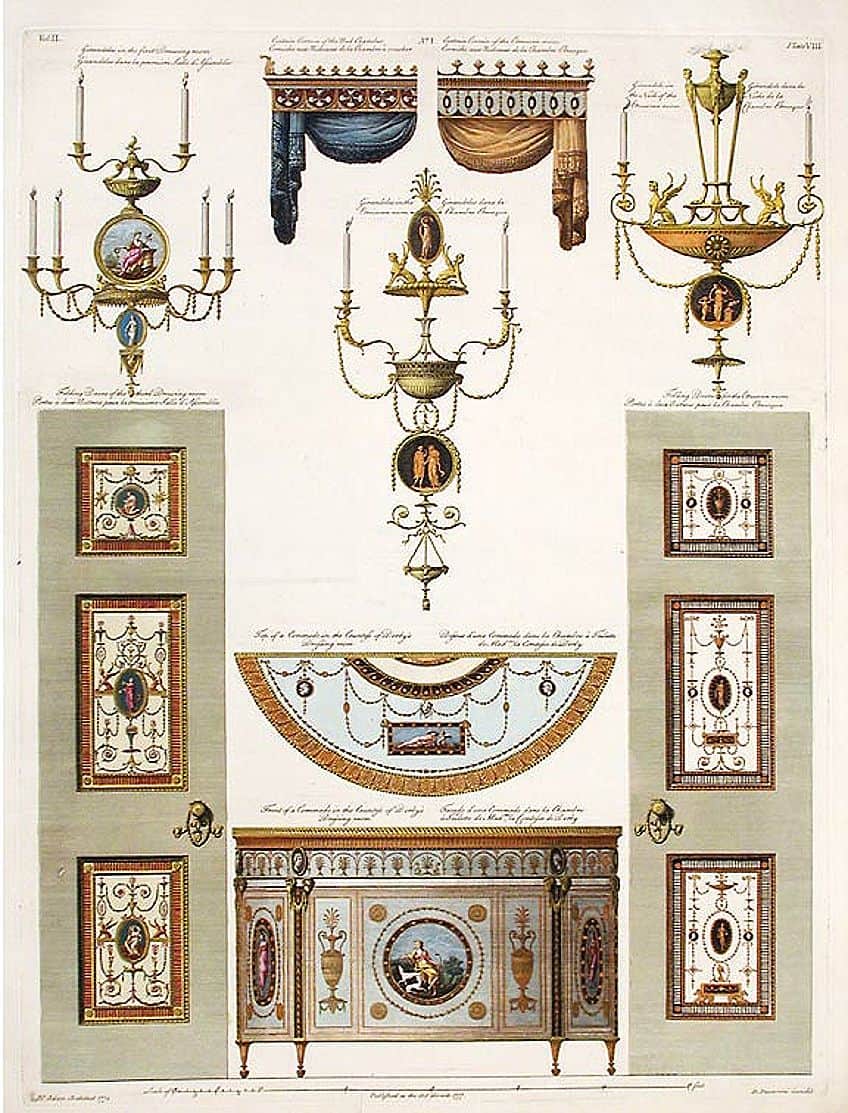 Details for Derby Business firm in Grosvenor Square(1777) past Robert and James Adam; See page for writer, Public domain, via Wikimedia Commons
The Renaissance vs. the Historic period of Enlightenment
Neoclassicism art was a revival of Classical ethics, and information technology is important to identify it contextually to empathize it as a movement. Neoclassicism was influenced by significant changes taking place in Europe, specifically 2 massive shifts within social club after the Medieval Ages.
We accept the Renaissance, which lasted from the 1300s to the 1600s. During this time in Europe, in that location were changes and advances in almost every aspect of human agreement and the humanities, for example, engineering science, science, mathematics, politics, and culture. And so we have the Historic period of Enlightenment (or Age of Reason), which started during the 1600s (17th Century) and lasted until the early on 1800s (xixth Century).
Artists during the Renaissance period sought to emulate the Classical ideals from the Greek and Roman periods. Fine art was naturalistic and true to reality, along with the philosophical ideals of Humanism, which placed the individual at the center of his artistic power. The term Renaissance ways "rebirth" and it was undoubtedly a rebirth of new means of seeing and exploring life.
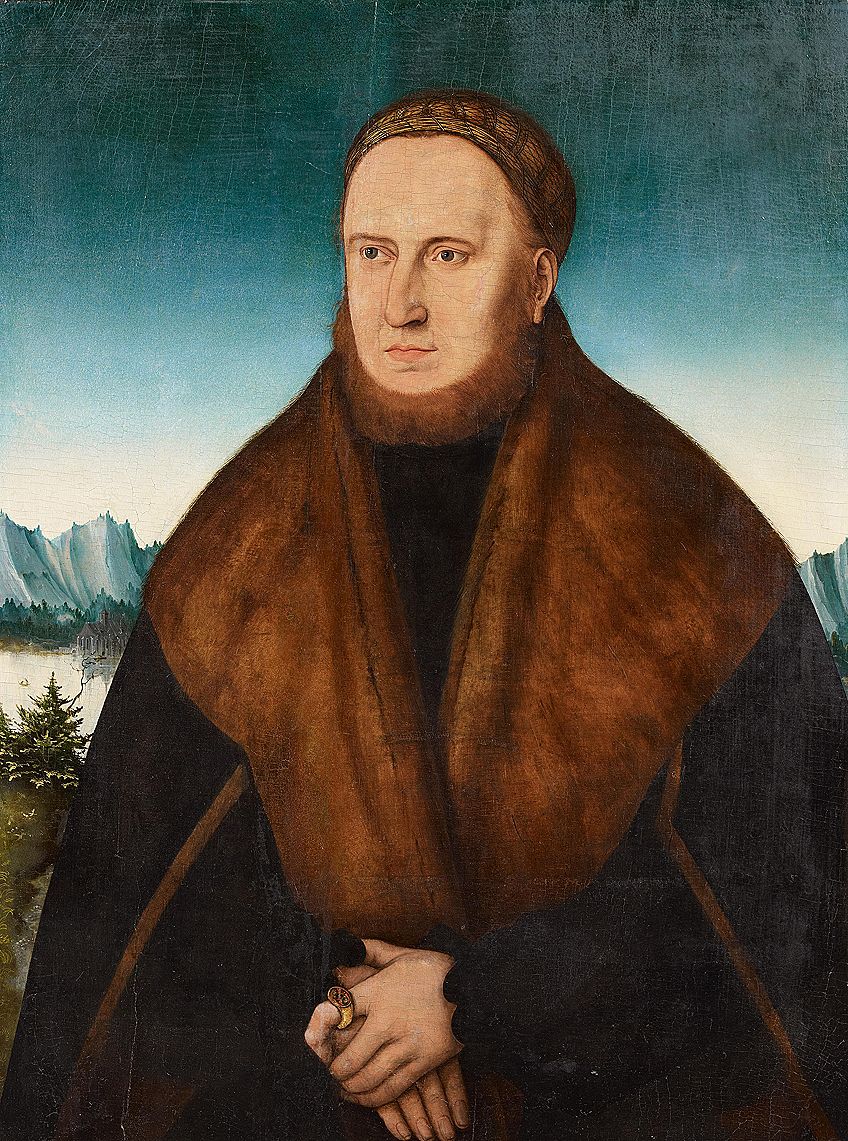 Portrait of a Bearded man with a Cap and a Fur-Tanned Glaze(1530) by a member of the Danube School; Circle of Lucas Cranach the Elder, Public domain, via Wikimedia Commons
The Age of Enlightenment, likewise Historic period of Reason, was founded in philosophical idea. Reason became the identifying cistron for many ideals like progress, liberty, fraternity, and tolerance, to proper noun a few. Reason and philosophical thought were regarded as a means of college agreement of man's place in the world.
The Age of Enlightenment was influenced by the Scientific Revolution, which developed during the final remnants of the Renaissance period. Information technology informed many of the scientific discipline-based faculties like mathematics, biology, physics, astronomy, chemistry, including homo beefcake. It replaced many ideas regarded as scientific, for example, astrology. It also utilized the new scientific method, which approached research with more scientific experimentation based on quantitative facts and observation.
This was as well what led to Empiricism, which believed noesis only derives from the external globe of the senses and feel.
Philosophers and scientists from the Enlightenment period were influenced by many of the ideas from the Scientific Revolution and they also had an educational groundwork in science. This period in history saw the authorisation of science over organized religion and how new fact-based concepts replaced the faith-based manner of viewing life and nature.
The forerunners of the Enlightenment and their seminal publications were cornerstones to the development of rational idea and set the foundations for the developments of this era. These included, among others, Isaac Newton's (1642-1727) Principia Mathematica (1686) and John Locke'southward (1632-1704) Essay Apropos Human being Understanding(1689).
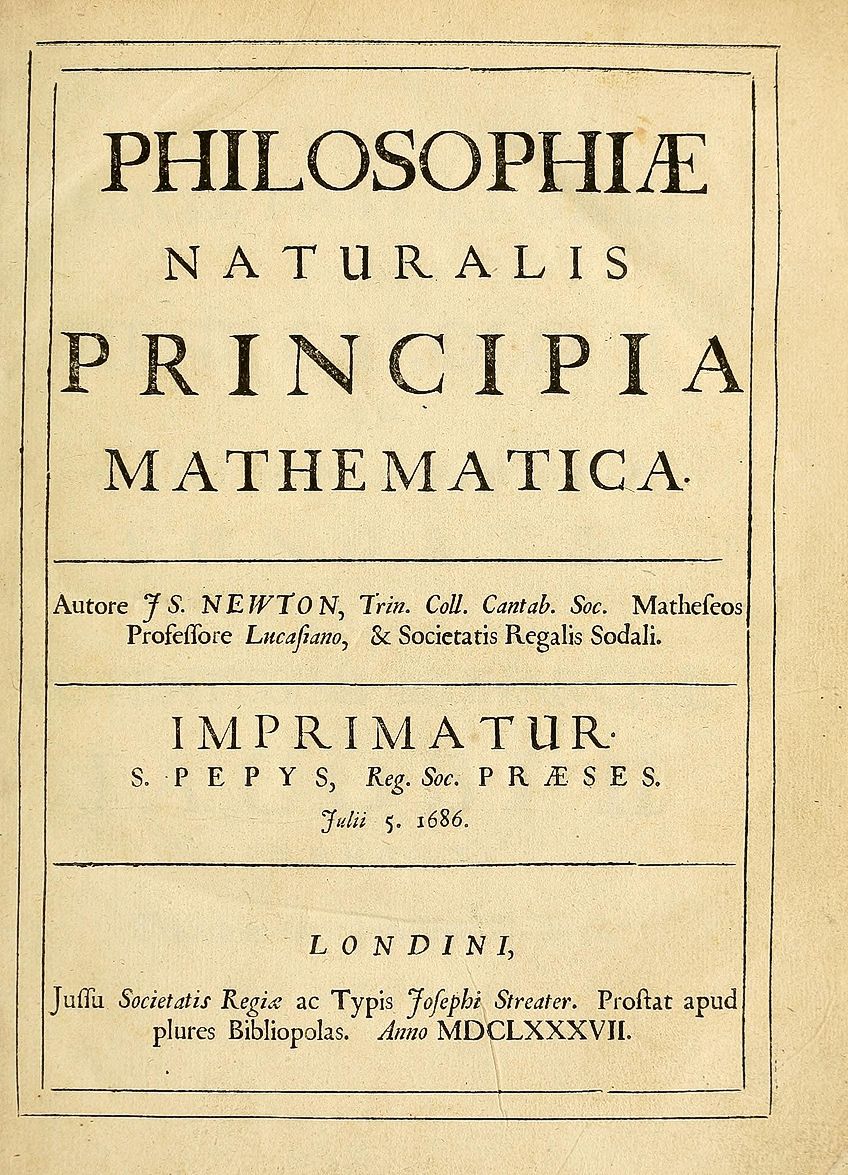 Championship Page of Principia(1687) by Isaac Newton;The original uploader was Zhaladshar at English Wikisource. , Public domain, via Wikimedia Eatables
The Influences and Development of Neoclassicism
Although the Enlightenment was a major proponent of the development of Neoclassicism, other major proponents included the piece of work of Johann Joachim Winckelmann (1717-1768) who wrote his seminal works on Classical art and compages and the rise of exploration in Europe, specifically the G Tour.
With the rise in popularity of the new fields of Archaeology and the earthworks of aboriginal sites like Herculaneum (excavated in 1738) and Pompeii (excavated in 1748), in that location was an increased curiosity to discover artifact. The Grand Bout fabricated a new mode of discovering antiquity possible throughout Europe.
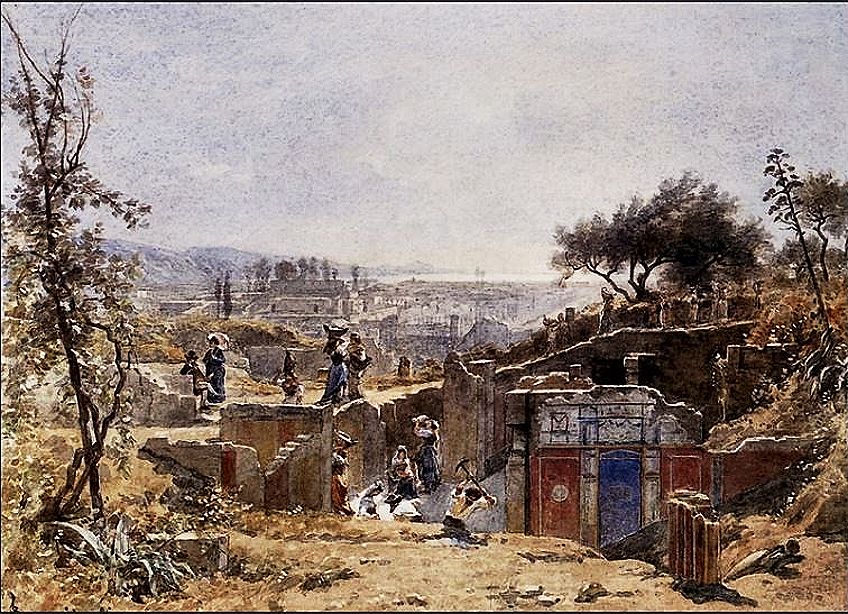 Excavations at Pompeii(1886) by François-Louis Français;François-Louis Français, Public domain, via Wikimedia Eatables
Information technology was washed as a rite of passage for young, coming of age, upper-class men, besides every bit artists and scholars seeking college education. It involved an extended menses of travel around the artistic and cultural hubs in Europe, which included Greece and Rome.
Although the One thousand Tour was only for the upper class, men brought back many souvenirs from their travels, and their extensive collections disseminated the fine art and civilization from the Classical era informing the Neoclassical movement.
It was also German, Winckelmann, that laid the foundation for art historical texts well-nigh Greek and Roman artworks, but likewise creating the first chronological ordering of Greek art and architecture inside a scholarly text. Winckelmann was famously known equally the "begetter" of fine art history every bit he wrote 2 of import publications that would go significant contributions in art history.
These two publications were, "Thoughts on the Imitations of Greek Works in Painting and Sculpture" (Gedanken über die Nachahmung der griechischen Werke in der Malerei und Bildhauerkunst (1750) and "The History of Art in Antiquity" (Geschichte der Kunst des Alterthums) (1764).
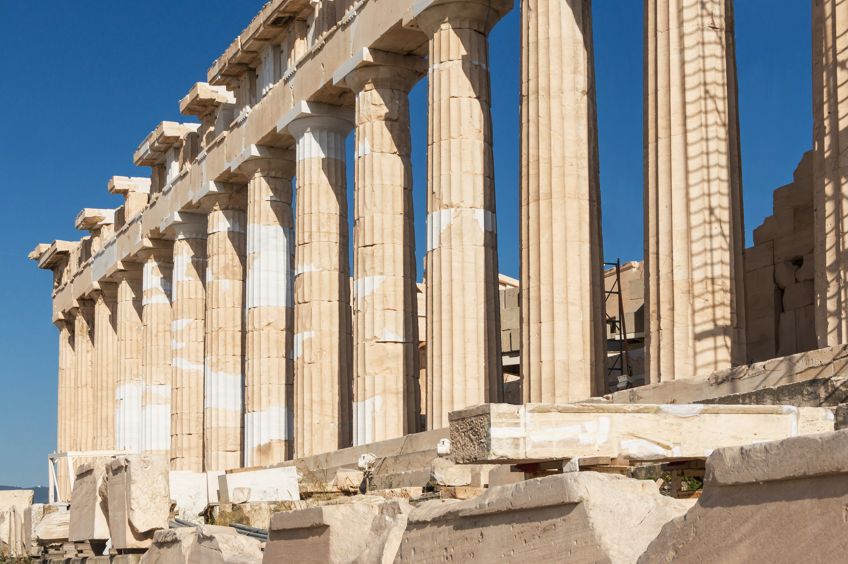 A photograph of the Colonnade Parthenon Acropolis in Athens, Greece (2015);Jebulon, CC0, via Wikimedia Commons
The offset publication had a profound effect on the theoretical frameworks of Neoclassicism every bit it explored the importance of imitating Greek Art. He is often quoted from his text, "the 1 fashion for us to become great, maybe inimitable, is by imitating the ancients". Withal, it is important to annotation at that place has been considerable argue amongst art scholars every bit to the context in which Winckelmann places his term "imitation".
It is also important to distinguish between the ideas of "imitating" and "copying" art, which are concepts Winckelmann expounded on in his reflections. He explored the Classical ethics extensively in his texts, although some scholarly sources also point that it is of import to identify his observations within careful context, namely that he never traveled to Greece himself, and he only came into contact with these artworks through Rome. Notwithstanding, his contributions impacted the world of fine art history for centuries to come.
The Key Characteristics of Neoclassical Art
At that place are many identifiable characteristics of Neoclassicism art, but one of the primary ideas of this art movement was the move away from the overly decorative style of the Baroque and Rococo fine art movements. We volition notice the Neoclassical fashion in painting, architecture, and sculpture. However, this style was not simply within the arts, merely it was besides dominant in music, theatre, and literature. Below we look at some of the common characteristics that ascertain and shape Neoclassical Art.
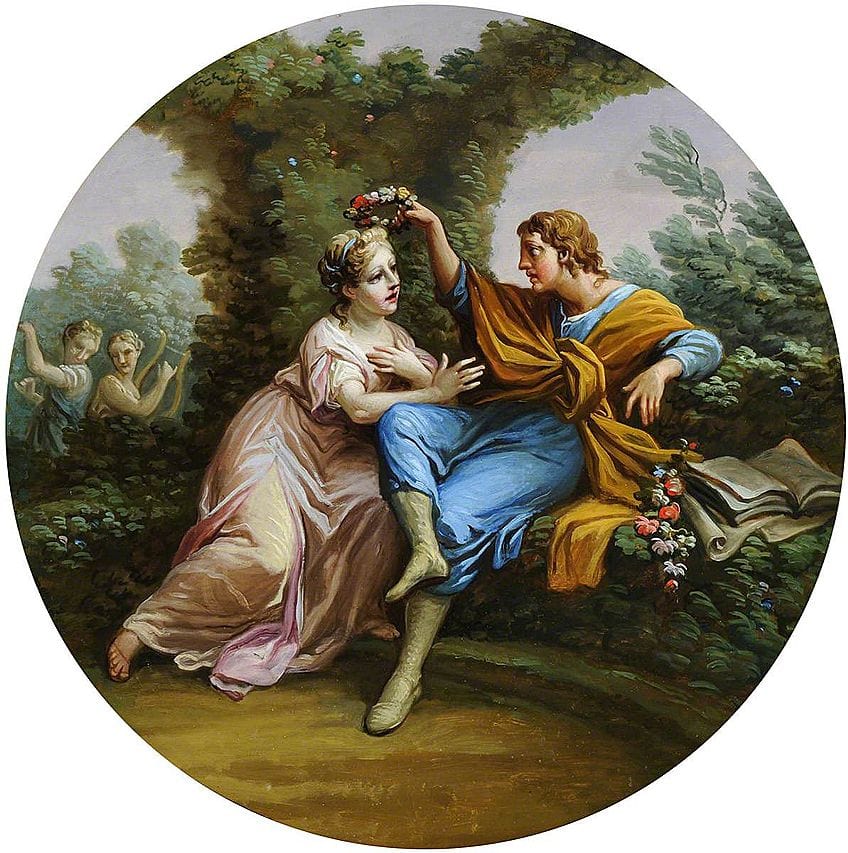 Daphnis Bestowing a Garland of Flowers on Chloe(1776) by Antonio Zucchi;Antonio Zucchi, Public domain, via Wikimedia Commons
Noble Simplicity
"Noble simplicity" is often cited from the forefather of the Neoclassical ethics, Johan Joachim Winckelmann in his publication "Thoughts on the Imitations of Greek Works in Painting and Sculpture" (1750), equally he writes near Greek sculptures and their inherent "quiet grandeur". He exemplifies this further with reference to the fine art of Raphael, who was 1 of the best-known painters during the Loftier Renaissance.
One of the primary characteristics of Neoclassical fine art was its return to ideals of "simplicity", "symmetry", "proportion", and "harmony". This simplicity of grade and shape was seen in Neoclassical painting, compages, and sculpture.
Information technology was a revival of the simplicity of grade and shape from the Greek and Roman periods. This simplicity was besides expressed through subdued and ofttimes tempered colors, which were meant to indicate a formality and a somewhat superiority. This chemical element of superiority was seen in the age of Artifact and many ideals related to morals and ideals.
Didactic Subject Thing
It was the stiff belief in virtues and morals that underpinned the narratives and effects of storytelling through Neoclassical painting. The type of subject matter utilized was of mythological scenes and characters, likewise as historical scenes taken from Greek and Roman sources. Information technology was also believed that Neoclassical Fine art was meant to help whoever viewed it by telling a story that inspired and gave a message based on morals and ethical values.
There was often an element of heroism in the narrative, also as a distinct seriousness and austerity. In other words, Neoclassical art was didactic, which means its message was meant to convey a lesson.
Famous Neoclassical Artists
Although there were many bully artists of the Neoclassical period, beneath we look at some of the more pop Neoclassical artists and their artworks within the fields of painting, sculpting, and architecture. There are ii important artists worth noting when it comes to influences on Neoclassical Art and they are, namely, Nicolas Poussin (1594-1665) and Claude Lorrain (c.1604-1682).
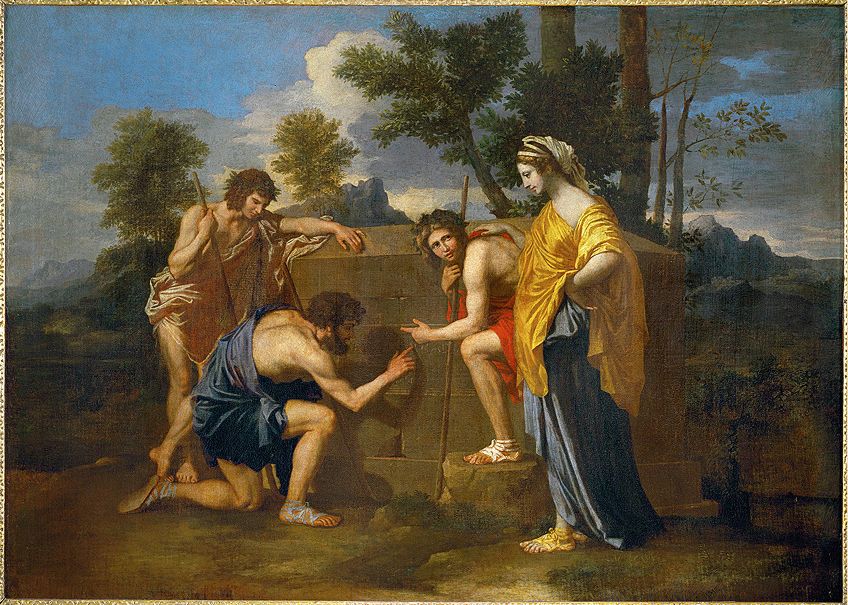 Et in Arcadia ego(1638-xl) by Nicolas Poussin; Nicolas Poussin, CC By-SA iii.0, via Wikimedia Commons
The above-mentioned artists were French, from the Bizarre period. However, their manner depicted the classical ideals of the orderliness of composition and historical scenes often from the Bible, mythology, or history. Nicolas Poussin was highly regarded for his paintings of the above-mentioned subject matter, including his more rational approach to painting versus expressiveness and ostentatiousness seen in Baroque Fine art.
Poussin's art was too influenced by Hellenistic principles and he painted in a way where those who viewed it would receive a deeper meaning from the narrative portrayed. He influenced notable Neoclassical painters like Jacques-Louis David.
Neoclassical Painting
Neoclassical painting can exist divided into two distinct developmental stages, namely, Early and Late Neoclassicism. It evolved as the reverse in way and composition to that of its precedent, the Rococo, where paintings appeared lighter and more improvident in style.
Neoclassical painting is characterized by a cleaner mode of brushwork and awarding, we volition see a smoother surface with brushstrokes creating solidity instead of airiness, furthermore, forms are depicted with more than solidity and definition. Color is likewise true to nature and subject area thing is portrayed true to history or mythology.
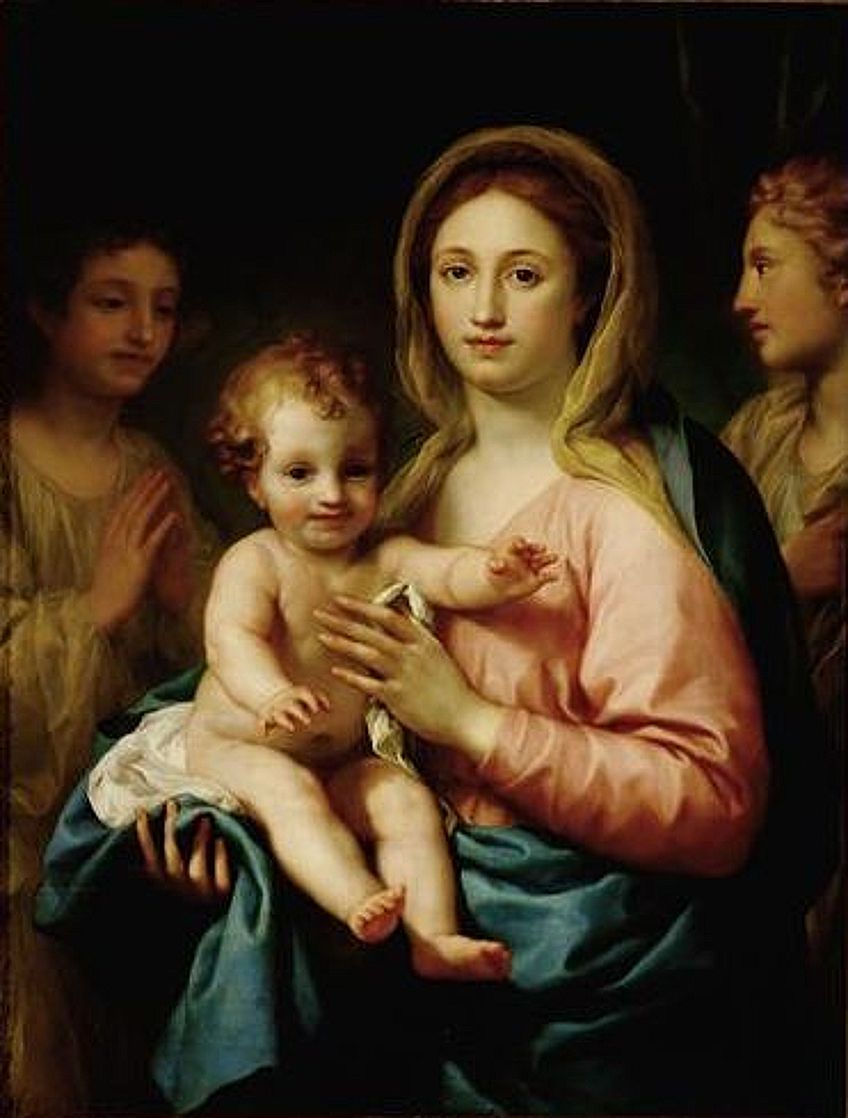 Maria mit dem Kind und zwei Engeln('Maria with the kid and 2 angels,' 1773) past Anton Raphael Mengs;Anton Raphael Mengs , Public domain, via Wikimedia Commons
The Neoclassical painting style adult in Rome with Anton Raphael Mengs (1728-1779) setting the foundations along with Johann Joachim Winckelmann. The style evolved in Britain with other notable artists like the Swiss Angelica Kauffman (1741-1807) and Benjamin West (1738-1820). During the Subsequently Neoclassical period, artists like Jacques-Louis David (1748-1825) led the style in France and became the epitome of the Neoclassical fashion.
The distinguishing factor for Neoclassical painting is that artists painted their subject matter from the examples they found from Ancient Greek and Roman architecture and sculpture, equally well as from examples of paintings before them, similar Bizarre and Rococo. Below we look at some of the artworks from the prominent Neoclassical painters of their time.
Anton Raphael Mengs (1728 – 1779)
Mengs was a Bohemian painter and considered 1 of the forerunners of Neoclassical painting, although he still painted within the Baroque manner at the fourth dimension. He believed in the significance and place of the Classical, this was also a shared value and belief with the Winckelmann, with who he worked closely. According to various scholarly sources, Mengs was described past Winckelmann equally the "greatest" creative person of his time.
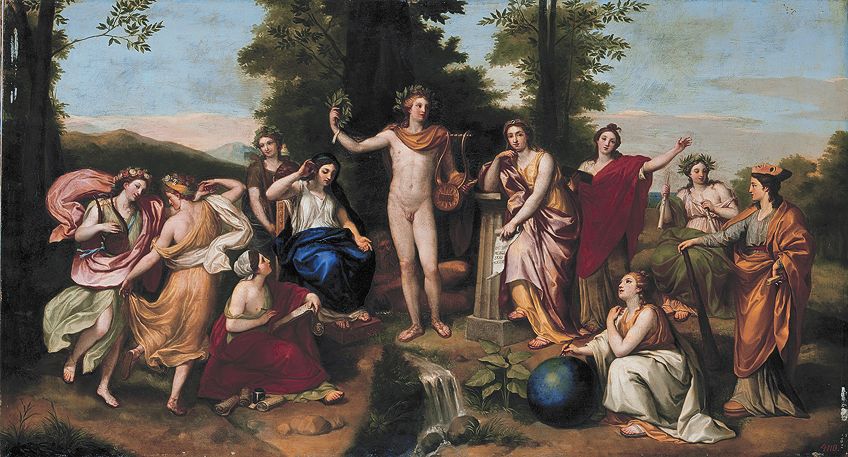 Parnassus(1761) by Anton Raphael Mengs;Anton Raphael Mengs , Public domain, via Wikimedia Eatables
One of his well-known artworks Parnassus (1761) depicts his move towards the Neoclassical period. It was created every bit an oil sketch as part of the fresco for the Villa Albani located in Rome. Mengs was inspired by Raphael'southward fresco similarly titled The Parnassus (c.1509-1511). Information technology depicts a mythological story nigh Apollo (the Sun God), which is in the center of the composition surrounded by various muses. In this painting by Mengs, we notice the more subdued coloring on the robes and cleaner lines of the form.
Benjamin West (1738 – 1820)
Benjamin Westward was an American-born painter, however, through his all-encompassing travels to Rome and then England he became ane of the popular British painters, with subject field matter centered on historical narratives. W also intended for his paintings to have a deeper moral significant. He was securely influenced by the Classical ideals from the Greek and Roman art he experienced during his travels to Rome, which he undertook during the 1760s, too the ideals and virtues from the Enlightenment.
West also studied under prominent scholars Winckelmann and collaborated with other popular artists of the time, namely Angelica Kaufmann and Gavin Hamilton (1723-1798). West has an extensive historical background, specially his time spent in England. He was a member of the Royal Academy of Arts in 1768, of which he became the president, and painted for King George Iii.
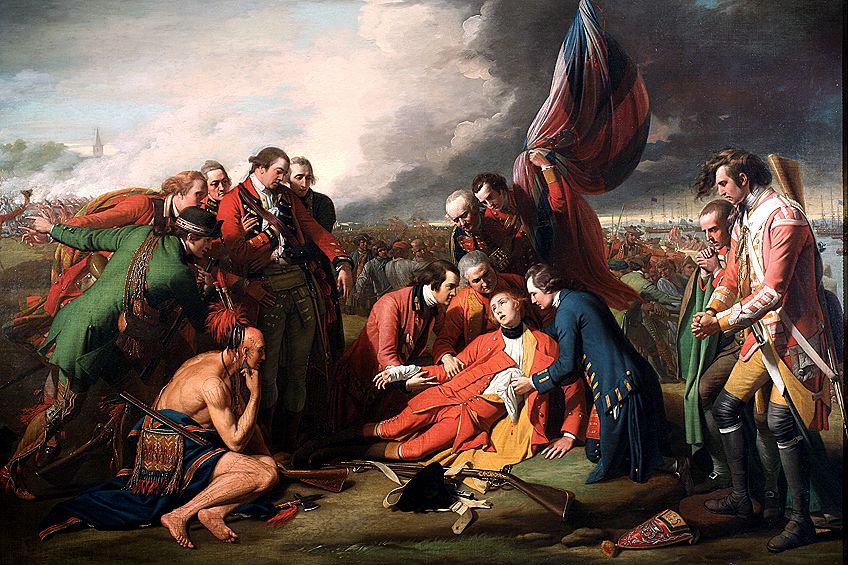 The Death of General Wolfe(1770) by Benjamin Westward;Benjamin West, Public domain, via Wikimedia Commons
Some of West's notable artworks include The Expiry of General Wolfe (1770), which was i of his about famous artworks depicting the Boxing of Quebec. What made this artwork so revolutionary was how West depicted the characters in their modern-24-hour interval uniforms, and not in classical dress, withal, this is reported to have been washed already by another artist, Edward Penny (1714-1791).
Angelica Kauffman (1741 – 1807)
Angelica Kaufmann was a Swiss-born artist and displayed artistic talent from a young historic period. She became a famous artist during her time in London, where she moved to after a period of traveling to Europe with her father. She managed to support herself successfully as a female creative person and was well respected as such past her community.
Kaufmann had a wide scope as a painter, including portraits, landscape, and decorative painting. She was known as having a mode related to Rococo Art, but she also adopted the Neoclassical style of history painting during the 1770s. She drew inspiration from Classical texts by writers like Homer and Alexander Pope. She too worked alongside Benjamin West, as another fellow member of the Royal Academy, and both artists popularized British historical paintings.
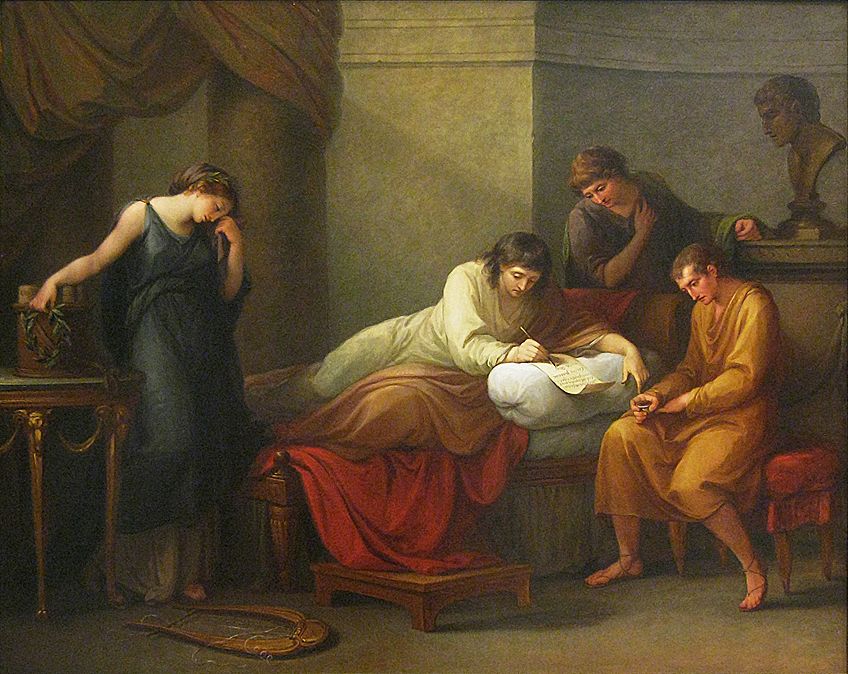 Virgil Writing his Epitaph at Brundisi(1785) by Angelica Kauffman;Carnegie Museum of Fine art, Public domain, via Wikimedia Eatables
Some of her more than famous artworks include Cornelia, Mother of the Gracchi, Pointing to Her Children every bit her Treasures(1785), wherein we notice the differences in how subject area matter is portrayed compared to the more light-hearted Rococo way. Axiomatic in this painting is a more serious tone, and figures are depicted in more subdued colors. The subject matter is also of Roman history of the politicians Tiberius and Gaius Gracchus.
Jacques-Louis David (1748 – 1825)
Jacques-Louis David is probably considered the epitome of Neoclassical painters and his artworks truly depict the essence of Neoclassical ideals and fashion. Born in Paris, David would go along his art career in Rome, where he too produced many of his virtually famous paintings, for example, The Oath of the Horatii (1784).
It is important to note that David produced his artworks during the same time of the French Revolution, and he was also a part of the French Revolution, specifically function of the Jacobin political club during 1789. His famous piece, The Oath of the Horatii (1784), was too associated with the French Revolution and what it stood for, but it is known that this slice was produced for a patron before the events of the Revolution.
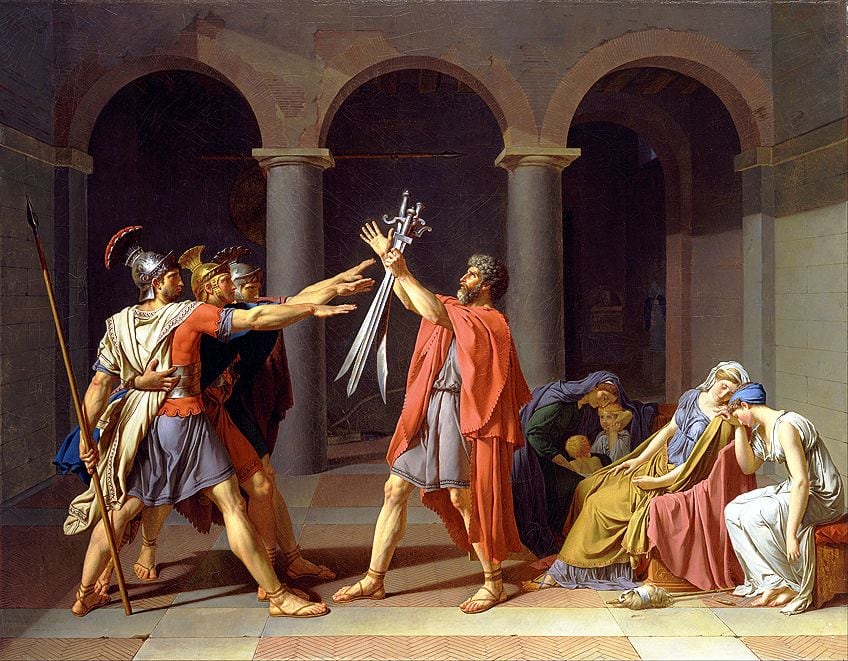 Oath of the Horatii(1786) past Jacques-Louis David;Anne-Louis Girodet de Roussy-Trioson, Public domain, via Wikimedia Eatables
When we await at this famous piece past David, we clearly notice the clean lines, symmetry, and heroic virtues so feature of the Neoclassical motility. It depicts the Roman story of the Horatii trio of brothers swearing to protect their country, Rome, against the Albans, of which also three brothers, the Curatii, would be their counterparts in battle.
The limerick clearly portrays the subject matter, we see the 3 brothers to the left and women mourning behind them (one of them in a relationship with ane of the Curatii brothers, which emphasizes their distraught emotions).
The cardinal figure is Horatius, holding upward three swords for the three brothers. Behind the figures, we notice three distinct arches, each one coinciding with the figures in the foreground.
The arches place more accent on the figures and what is taking place in the foreground, this, again, is highlighted by the stark lighting making the whole scene clear. We observe David keeps the composition simple and does not distract by adding any other elements or decorations to the painting. The three arches in the background create a seeming backdrop, which "sets the phase", so to say, for the key figures in the foreground.
Other important artworks past David include the Death of Marat (1793), which depicts the dead body of Jean-Paul Marat, who was murdered by Charlotte Corday. Marat was a French politician and journalist, among other merits. This painting was done during the elevation of the French Revolution and what was known as the Reign of Terror, which consisted of public executions and numerous massacres.
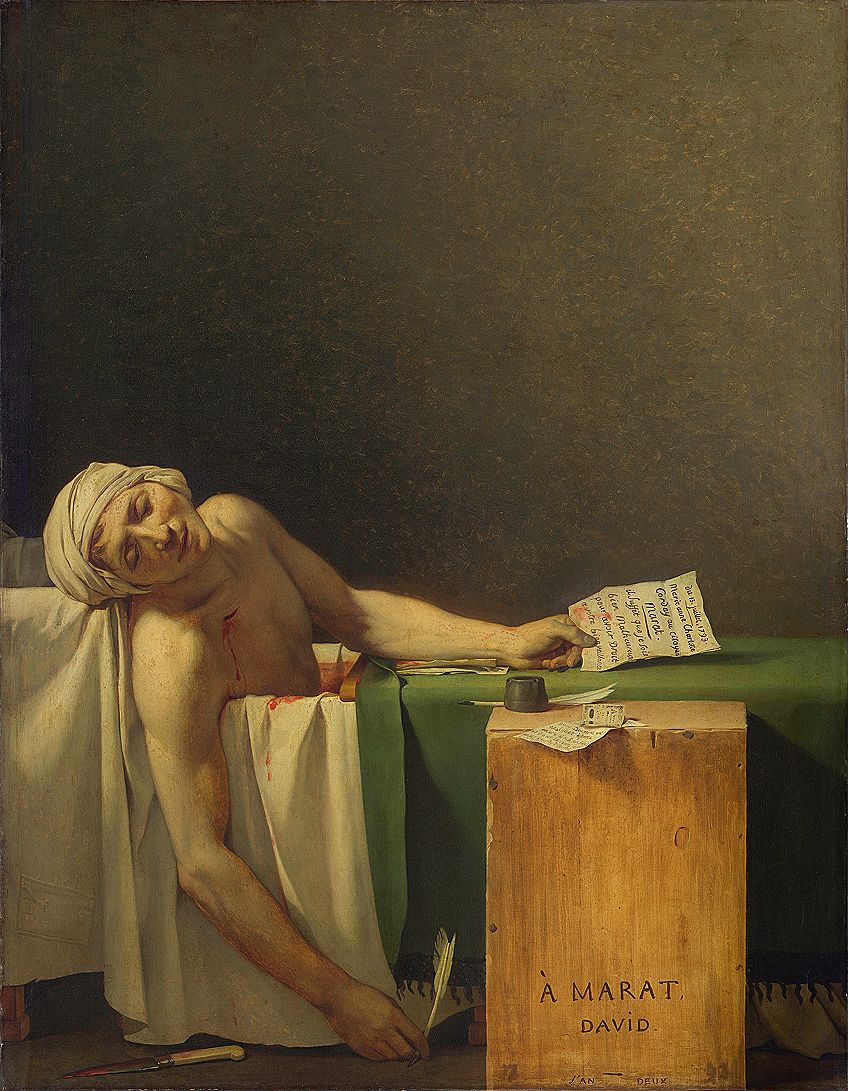 The Expiry of Marat(1793) by Jacques-Louis David; Jacques-Louis David, Public domain, via Wikimedia Commons
This painting was washed in memory of Marat and we volition notice how David idealized the dead figure using Biblical references of Christ'due south dead trunk. This is evident in the Marat's hanging arm, symbolizing Christ's arm with reference to the Michelangelo's marble sculpture titled, Pietà, the turban around his head, which is a symbol for a halo, and the seeming gracefulness of his dead trunk – there is a sense of martyrdom depicted.
What makes the painting more real is the letter of the alphabet in Marat's hand, which is clearly readable. It is from Charlotte Corday herself, it is written in French and translated to English, it reads: "July 13, 1793. Marie Anne Charlotte Corday to the denizen Marat – Given that I am unhappy, I take a right to your assistance".
Jean-Auguste-Dominique Ingres (1780 – 1867)
Ingres was another prominent French Neoclassical painter who studied under the tutelage of Jacques-Louis David. He was a strong proponent of Poussin's style of art, which was towards more rational and clear approaches to depicting elements like form and line. However, we will notice there is more expressiveness of course in his paintings, which is reminiscent of the attributes associated with Romanticism.
An example of i of his artworks is the La Grande Odalisque (1814), which depicts a nude woman staring at the onlooker. This artwork has continued into the Modern era in terms of the identify of female person nudes and the human relationship with the male equally the onlooker.
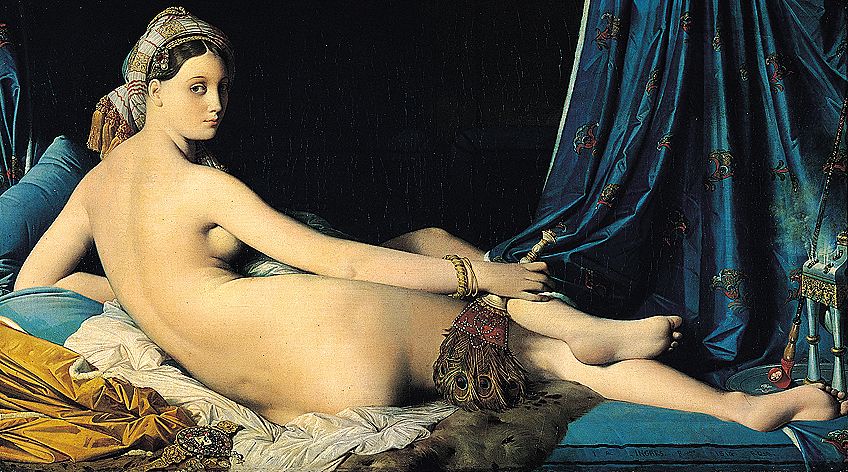 La Grande Odalisque(1814) by Jean Auguste Dominique Ingres;Jean-Auguste-Dominique Ingres, Public domain, via Wikimedia Eatables
We also find how Ingres is still utilizing the subject matter every bit a female nude, characteristic of the Classical era, he besides utilizes the, often termed, "clean lines", characteristic of Neoclassical art, but he moves beyond the rigidity of Neoclassicism in the way he depicts the nude – there is more expressiveness and a turn abroad from the overt realism of human course as we notice her proportions are not exactly true to nature.
Neoclassical Sculpture
Neoclassical sculptures drew considerable inspiration from the archaeological digs in Rome and Greece at the fourth dimension, especially that of Pompeii. Sculptors were also provided with a broad variety of models to work from, this was quite the contrary for Neoclassical paintings, which had a bottom number of real-life examples to work from to emulate the Classical ideals.
Some mutual characteristics of Neoclassical sculpture include its size, sculptures would often be fabricated life-sized and focused on symmetrical correctness. Field of study matter often had a more serious tone but would range from mythological, to historical, even to real-life personalities like actors, singers, and famous philosophers as is evident in the work of Jean-Antoine Houdon (1741-1828), who produced his famous portrait busts.
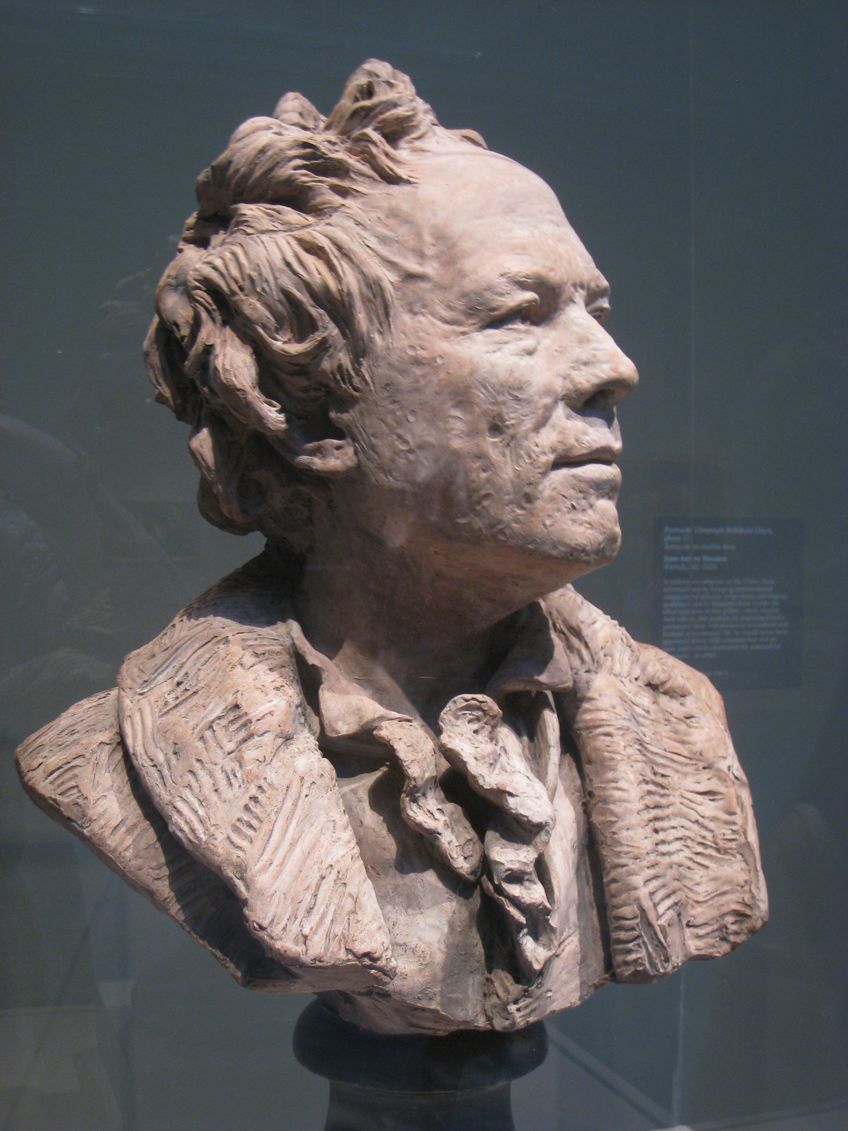 Bust of Christoph Willibard Gluck(1775) by Jean-Antoine Houdon; Jean-Antoine Houdon, Public domain, via Wikimedia Commons
Some other common trait among Neoclassical sculptors was a combination of depicting subject matter in idealistic forms or with naturalism and realism referred to equally verism, which was besides referred to as "warts and all". This mode of depiction was used in Roman sculpture and believed in including all the traits seen on a trunk, whether it be warts, wrinkles, or anything else that would be considered "imperfections" – this gave a heightened sense of realism.
Some of the summit Neoclassical sculptors included Jean-Antoine Houdon (mentioned above), who was in France as a leading sculptor during the French Enlightenment catamenia, Antonio Canova (1757-1822), and Bertel Thorvaldsen (1770-1844), who were pioneering sculptors working in Rome.
Each sculptor had a different approach. However, they are also noted to accept depicted a sense of idealism in their sculptures.
Thorvaldsen and Canova sculpted mythological subject affair, examples of their sculptures include Canova's Psyche Revived by Cupid's Kiss (1787-1793), housed in the Louvre in Paris. It depicts Cupid and Psyche in the throes of kissing later on she was woken up past Psyche himself with a kiss. Canova was born Italian and primarily worked in Rome. He was well-known to have produced work that was more "warm" and light in its portrayal.
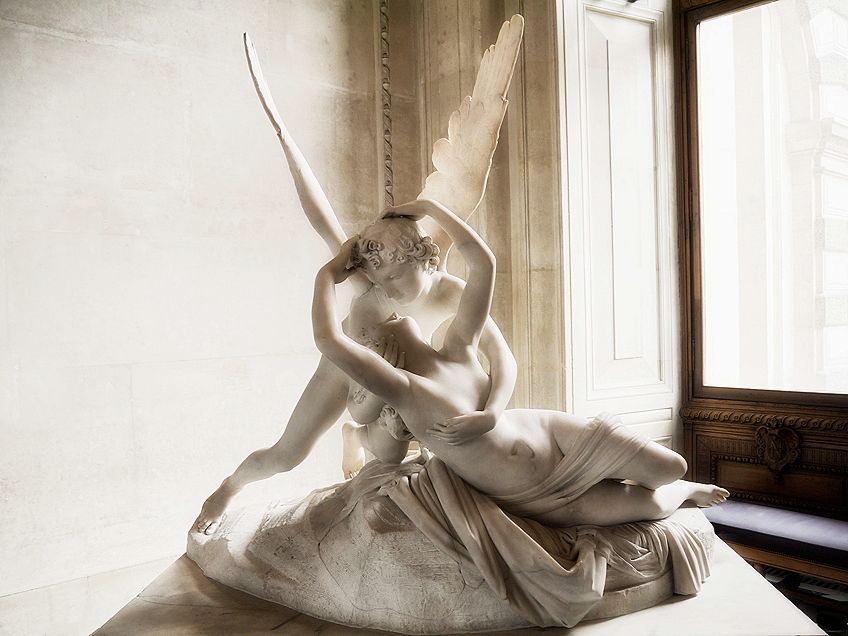 Psyche Revived by Cupid'southward Kiss(1787) by Antonio Canova; Kurtab123, CC BY-SA 4.0, via Wikimedia Commons
Thorvaldsen worked in Rome during his adult years and focused on works that were heroic in nature. He was original of Danish descent, born in Copenhagen. An example of his work includes Jason with the Golden Fleece(1802-1803) and Monument to Copernicus (1822-1830).
Many sources indicate that Thorvaldsen's work has been described as more than "severe" in its style. He depicted his field of study matter with a sense of dignity and heroism. We are able to notice this sense of severity in his well-known piece of work Jason and the Golden Fleece (1802-1803), having depicted the mythological grapheme of Jason with a sense of heroic prowess, even though the actual character of Jason in mythology was not hailed exactly as a hero.
Neoclassical Architecture
Neoclassical architecture became a testament to the ethics and virtues in Neoclassicism. There have been endless buildings of all types synthetic inside the Neoclassical style. Neoclassical compages also conveys seriousness and orderliness in its construction and facades, then to say, having imitated Greek and Roman architecture. It started flourishing during the middle of the xviiith Century and constitute all over Europe in countries like Frg, France, Russia, and United kingdom of great britain and northern ireland.
The Neoclassical architectural style was besides influenced past two of import architects, namely, the Roman Vitruvius, from the 1st Century BC, and the Renaissance architect Andrea Palladio (1508-1580). Palladio was known for simplifying the already existing architectural structures and elements existent from the Renaissance.
He was influenced by Greek and Roman architecture; however, it is too noted that he did not exactly imitate these structures, but included his own elements to introduce new designs. He was likewise similarly influenced past Vitruvius and how he utilized elements similar symmetry and proportion.
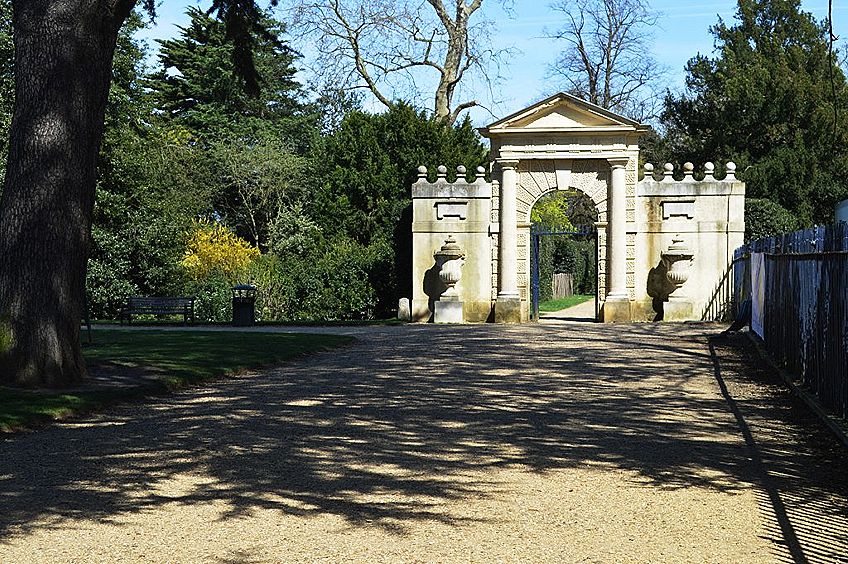 A photo of Inigo Jones' Portal at Chiswick House built in 1621;Matt Brown from London, England, CC BY ii.0, via Wikimedia Commons
Common characteristics of Neoclassical compages include the focus on planar surfaces versus the more sculptural surfaces seen in the Baroque and Rococo styles of architecture. It also utilized the Classical Orders, which consisted of columns like the Doric, Ionic, and Corinthian. These orders were prevalent in Greek architecture and similarly used in the Neoclassical buildings.
Other features include the emphasis on walls appearing long and, especially, bare in its surface. It is classified every bit utilizing geometric shapes, clean lines, and "block" shapes. The cake shape (rectangular or squared) in Neoclassical compages is widely visible, information technology is frequently coupled with a apartment roof and a dome, with a repetition of columns.
Neoclassical architecture also consisted of two phases, or periods, namely, Early on, or Palladian, and High Neoclassical compages.
The Early period was during the 1700s to 1750s and was significantly influenced past Palladio. The forerunners of this period were architects similar Inigo Jones (1573-1652) and Colen Campbell (1676-1729). A well-known example of this style is the Chiswick House (1729) by Richard Boyle (1694-1753). Every bit the iiird Earl of Burlington and 4th Earl of Cork, he was built-in into an Anglo-Irish family in Yorkshire. He was popular for introducing the Palladian way of architecture in Britain and Ireland, oft also referred to as the "Architect Earl".
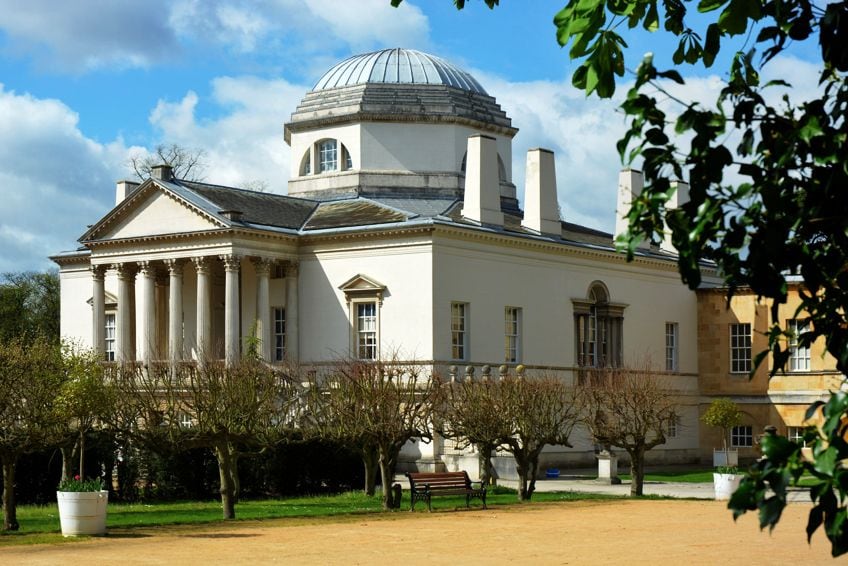 A photograph of Chiswick House designed by architects Richard Boyle and William Kent in 1729;Images George Rex from London, England, CC BY-SA ii.0, via Wikimedia Eatables
When nosotros look at the Loftier Neoclassical architecture, which started during the 1750s, it incorporated more than influence from Greek architecture, which was not as prevalent in the before period. This style is too just known as Neoclassical architecture. Of the countless examples of buildings in this way, common examples include the Hermitage Museum (1787) in Russia.
Another famous building is the Panth é on (1758-1790) in Paris, initially, it was the Church of St. Geneviève. It was built by Jacques-Germain Soufflot (1713-1780). This edifice, in all its magnificence, located in the 5th arrondissement, is a true testament to the Classical ideals from Greek and Roman compages, evident in its numerous columns and geometric proportions.
The Ever Continued Neoclassical
The Neoclassical fashion ended during the 1850s with the rising of a new movement chosen Romanticism, which started during the 1780s and lasted until effectually the 1830s. Information technology coincided with Neoclassicism and was about the complete opposite in style and values. Where Neoclassicism was about rationality and Classical ideals of virtue and order, Romanticism expressed emotion and the exploration of the senses.
Although this was a complete shift in manner, the Neoclassical movement continued and lived on in the Classical ideals that it sought to emulate. Nosotros will still discover the Neoclassical way in many types of buildings throughout Europe. It was besides revived within the Beaux-Arts Architecture, which was a French and American movement during the 1830s into the 1940s.
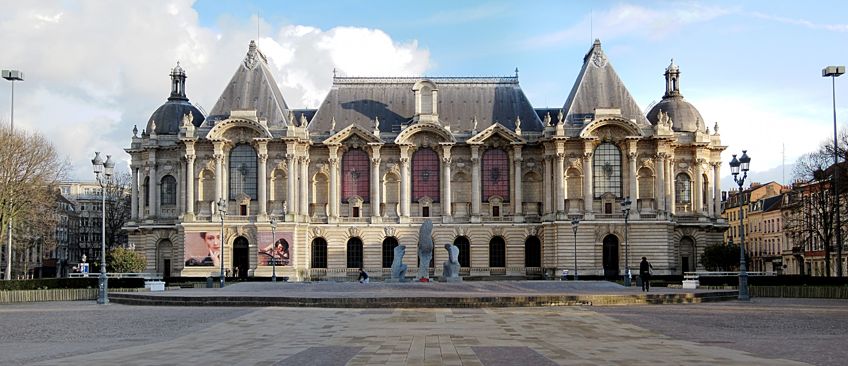 A photograph of Lille Palais des Beaux Arts designed in 1809 by Fernand Delmas and Édouard Bérard;Velvet, CC BY-SA iii.0, via Wikimedia Eatables
Neoclassicism was a return to the Classics – it sought to revive the ethics of the ancients, namely, gild, symmetry, and rationality. It nearly dutifully depicted what the Classics attained during the Greek and Roman periods and similarly strove to attain in the context of the eighteenth Century and its circuitous and frequently tumultuous development into the Modernistic era.
The revival of Classical ideals inside Neoclassical Art was almost a period of reminding the world again via visual advice of the beauty and structure so perfected by the ancients (whether they knew it or not) – and just we can dream of attaining that in our own Age of Enlightenment.
Take a look at our Neoclassicism webstory hither!
Ofttimes Asked Questions
What Is Neoclassicism?
Neoclassicism was a revival of Classical ideals from the Greek and Roman periods. It was likewise a reaction towards the exuberant and often described "flamboyant" nature of the preceding movements, Baroque and Rococo.
When Was the Neoclassical Period?
The Neoclassical catamenia started in Europe around the middle of the 1700s (18th Century) and connected during the 1900s (19th Century). Information technology initially had roots in Rome but spread to many other countries, primarily France and Great britain, just besides Russia and Germany, among others.
What are the Main Characteristics of Neoclassicism?
As an opposing motion to the Baroque and Rococo, Neoclassicism reverted to Classical virtues of symmetry, proportion, clean lines, and subdued colors. The subject thing was of mythological and historical scenes with the ideals of heroism and patriotism. Information technology was besides inspired past rational idea and calmness of being.
What Influenced the Neoclassical Movement?
It is believed in that location were 3 primary influences on the development of Neoclassicism, namely, the seminal and revolutionary texts of historian, Johann Joachim Winckelmann (1717-1768), almost defining the periods of Greek and Roman art and architecture. Then there were the excavations of Pompeii and Herculaneum, which introduced new artifacts and knowledge virtually Classical Antiquity, and lastly, the One thousand Bout, which allowed many noble immature men and artists to tour Europe (especially Greece and Rome) and bring back many artifacts and memorabilia, which inspired the development of the revival of Classical culture.
southwicklited1956.blogspot.com
Source: https://artincontext.org/neoclassical-art/
0 Response to "What Is True of the Neoclassical Style of Art"
Post a Comment