What Happens to Cardiac Output During an Electrical Rhythm Disturbance?
Overview
What is an arrhythmia?
An arrhythmia (too chosen dysrhythmia) is an irregular or abnormal heartbeat.
What is my pulse?
Your pulse indicates your heart rate, or the number of times your centre beats in i infinitesimal. Pulse rates vary from person to person. Your pulse is slower when you are at rest and increases when y'all exercise, since more oxygen- rich blood is needed by the body during practise.
How practise I accept my pulse?
Y'all can tell how fast your heart is chirapsia past feeling your pulse. You can feel your pulse on your wrist or cervix. Place the tips of your index and eye fingers on the inner wrist of your other arm, just below the base of your thumb. Or, place the tips of your index and centre fingers on your lower neck, on either side of your windpipe. Printing lightly with your fingers until you experience the blood pulsing beneath your fingers. You may need to move your fingers around slightly upward or downward until yous feel the pulsing.
Yous can count the number of beats in 10 seconds and multiply past six to determine your heart rate in beats per minute. A normal heart rate, at rest, is 50 to 100 beats per minute.
Your Heart Rate: Pulse in ten seconds x half dozen = _
Acquire more about your pulse and target eye rate.
Center Rhythms on ECG
The centre's electrical arrangement triggers the heartbeat. Each trounce of the heart is represented on the electrocardiogram (EKG or ECG) by a wave arm.
The normal heart rhythm (normal sinus rhythm) shows the electric action in the centre is following the normal pathway. The rhythm is regular and the node is normal (about fifty to 100 beats per infinitesimal).
Tachycardia: fast middle rhythm (greater than 100 beats per minute)
Bradycardia: dull eye rhythm (less than 60 beats per minute)
The Heart's Electric System
The atria (the heart's upper chambers) and ventricles (the heart's lower chambers) piece of work together, alternately contracting and relaxing to pump claret through the heart. The electrical system of the heart is the power source that makes this possible. Here's what happens during a normal heartbeat:
Irregular heart rhythms can also occur in normal, healthy hearts. Arrhythmias can also be caused past certain substances or medications, such as caffeine, nicotine, alcohol, cocaine, inhaled aerosols, diet pills, and coughing and cold remedies. Emotional states such equally stupor, fright or stress can also crusade irregular heart rhythms.
Arrhythmias that are recurrent or related to an underlying centre condition are more than concerning and should ever be evaluated by a doctor.
In about cases, treating the underlying status will take care of the arrhythmia. If non, many medications and procedures are available to eliminate or control the abnormal centre rhythm.
What are the types of arrhythmias?
- Tachycardia: A fast center rhythm with a rate of more than 100 beats per minute.
- Bradycardia : A slow heart rhythm with a rate below 60 beats per minute.
- Supraventricular arrhythmias: Arrhythmias that begin in the atria (the heart'southward upper chambers). "Supra" ways above; "ventricular" refers to the lower chambers of the heart, or ventricles.
- Ventricular arrhythmias: Arrhythmias that begin in the ventricles (the centre's lower chambers).
- Bradyarrhythmias: Tedious eye rhythms that may be caused by disease in the heart'due south conduction system, such every bit the sinoatrial (SA) node, atrioventricular (AV) node or His-Purkinje network.
Types of Supraventricular Arrhythmias
Supraventricular arrhythmias begin in the atria
Types of supraventricular arrhythmias include:
Premature atrial contractions (PACs)
Early, extra heartbeats that originate in the atria.
Paroxysmal supraventricular tachycardia (PSVT)
A rapid but regular heart rhythm that comes from the atria. This type of arrhythmia begins and ends suddenly.
Accessory pathway tachycardias (bypass tract tachycardias)
A fast heart rhythm caused by an extra, aberrant electrical pathway or connection betwixt the atria and ventricles. The impulses travel through the extra pathways every bit well equally the usual road. This allows the impulses to travel effectually the heart very quickly, causing the heart to shell unusually fast (example: Wolff- Parkinson-White syndrome).
AV nodal re-aspirant tachycardia (AVNRT)
A fast heart rhythm acquired past the presence of more one pathway through the atrioventricular (AV) node.
Atrial tachycardia
A rapid centre rhythm that originates in the atria.
Atrial fibrillation
A very common irregular heart rhythm. Many impulses brainstorm and spread through the atria, competing for a take a chance to travel through the AV node. The resulting rhythm is disorganized, rapid and irregular. Because the impulses are traveling through the atria in a disorderly fashion, there is a loss of coordinated atrial contraction.
- Learn more about atrial fibrillation.
Atrial palpitate
An atrial arrhythmia caused by one or more rapid circuits in the atrium. Atrial palpitate is usually more organized and regular than atrial fibrillation.
Types of Ventricular Arrhythmias
A ventricular arrhythmia begins in the heart's ventricles.
Types of ventricular arrhythmias include:
Premature ventricular contractions (PVCs)
Early, extra heartbeats that originate in the ventricles. Most of the time, PVCs don't cause any symptoms or require treatment. This blazon of arrhythmia is mutual and can be related to stress, too much caffeine or nicotine, or exercise. They can be too be acquired past heart affliction or electrolyte imbalance. People who have several PVCs and/or symptoms associated with them should be evaluated by a cardiologist (eye doctor).
- Learn more about premature ventricular contractions.
Ventricular tachycardia (V-tach)
A rapid heartbeat that originates in the ventricles. The rapid rhythm keeps the heart from adequately filling with blood, and less blood is able to pump through the body. 5-tach can be serious, especially in people with eye disease, and may exist associated with more than symptoms than other types of arrhythmia. A cardiologist should evaluate this condition.
- Acquire more nigh ventricular tachycardia.
Ventricular fibrillation (V-fib)
An erratic, disorganized firing of impulses from the ventricles. The ventricles quiver and cannot generate an effective wrinkle, which results in a lack of claret being delivered to the body. This is a medical emergency that must be treated with cardiopulmonary resuscitation (CPR) and defibrillation (delivery of an energy shock to the eye muscle to restore a normal rhythm) as soon equally possible.
- Learn more about sudden cardiac death.
Long QT
The QT interval is the surface area on the ECG that represents the fourth dimension information technology takes for the middle muscle to contract and then recover, or for the electric impulse to fire and so recharge. When the QT interval is longer than normal, it increases the chance for "torsade de pointes," a life-threatening class of ventricular tachycardia.
- Learn more about long QT Syndrome (LQTS)
Types of Bradyarrhythmias
A bradyarrhythmia is a dull heart rhythm that is usually caused past affliction in the heart's conduction system. Types of bradyarrhythmias include:
Sinus node dysfunction
Slow heart rhythms due to an abnormal SA node.
Heart block
A delay or complete block of the electrical impulse equally it travels from the sinus node to the ventricles. The level of the block or filibuster may occur in the AV node or His-Purkinje system. The heartbeat may be irregular and tedious.
- Acquire more about heart block.
Management and Treatment
How is an arrhythmia treated ?
Treatment depends on the type and severity of your arrhythmia. In some cases, no treatment is necessary. Handling options include medications, lifestyle changes, invasive therapies, electric devices or surgery.
Medications
Antiarrhythmic drugs are medications used to convert the arrhythmia to a normal sinus rhythm or to forbid an arrhythmia. Other medications may include heart rate-control drugs and anticoagulant or antiplatelet drugs such as warfarin (a "blood thinner") or aspirin, which reduce your risk of stroke or developing claret clots.It is important that you know the names of your medications, why they are prescribed, how often and at what times to take them, what side effects may occur, and what medications you have previously taken for your arrhythmia.
- Common Medications for Arrythmias
Lifestyle changes
Arrhythmias may be related to sure lifestyle factors. The post-obit tips tin help limit the occurrence of arrhythmias:
- If y'all smoke, stop.
- Limit your intake of booze.
- Limit or stop using caffeine. Some people are sensitive to caffeine and may notice more symptoms when using caffeinated products, such equally tea, coffee, colas and some over-the- counter medications.
- Avert using stimulants. Beware of stimulants used in cough and cold medications and herbal or nutritional supplements. Some of these substances incorporate ingredients that crusade irregular center rhythms. Read the label and ask your doctor or chemist which medication is best for y'all.
- Your family may also desire to be involved in your care past learning to recognize your symptoms and how to outset CPR if needed.
- If y'all notice that your irregular heart rhythm occurs more often with certain activities, you should avoid them.
Invasive therapies
Electrical cardioversion and catheter ablation are invasive therapies used to treat or eliminate irregular centre rhythms. Your md will decide the best handling for y'all and discuss the benefits and risks of these therapies with y'all.
- Electrical cardioversion Patients with persistent arrhythmias, such as atrial fibrillation, may not be able to reach a normal heart rhythm with drug therapy alone. Electric cardioversion delivers an electrical shock to your chest wall, which synchronizes the heart and allows the normal rhythm to restart. This procedure is washed subsequently yous receive curt-interim anesthesia.
- Catheter ablation : During ablation, energy is delivered through a catheter to tiny areas of the eye muscle. This energy can either "disconnect" the pathway of the abnormal rhythm, block the abnormal pulses and promote normal conduction of impulses, or disconnect the electrical pathway between the atria and the ventricles.
- Pulmonary vein isolation: In patients with frequent, paroxysmal or persistent atrial fibrillation, isolation of the pulmonary veins is a procedure that uses special catheters to render bands of vein tissue, thought to cause atrial fibrillation, dysfunctional. The goal is to isolate, rather than ablate, the foci responsible for triggering atrial fibrillation through a circumferential conduction block.
- Electrical devices
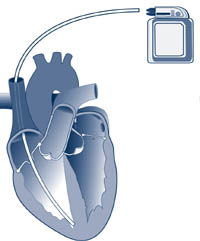
- Permanent pacemaker : A device that sends small-scale electric impulses to the heart muscle to maintain a normal heart rate. The pacemaker has a pulse generator (which houses a battery and a tiny calculator) and leads (wires) that send impulses from the pulse generator to your middle muscle, also every bit sense the eye'south electrical activity. Pacemakers are mostly used to prevent the heart from beating too slowly. Newer pacemakers accept many sophisticated features that are designed to help manage arrhythmias, optimize heart rate-related functions and improve synchronization.
- Implantable cardioverter-defibrillator (ICD) : A sophisticated electronic device used primarily to treat ventricular tachycardia and ventricular fibrillation — 2 life-threatening abnormal heart rhythms. The ICD constantly monitors the eye rhythm. When information technology detects a very fast, abnormal heart rhythm, it delivers energy to the heart musculus to cause the heart to beat in a normal rhythm again.
There are several means an ICD can restore a normal heart rhythm:
- Antitachycardia pacing (ATP): When the middle beats likewise fast, a series of pocket-sized electrical impulses are delivered to the eye muscle to restore a normal heart rate and rhythm.
- Cardioversion: A low-free energy shock is delivered at the same time equally the heartbeat to restore a normal eye rhythm.
- Defibrillation: When the heart is beating dangerously fast or irregularly, a higher energy shock is delivered to the heart muscle to restore a normal rhythm.
- Antibrachycardia pacing: Many ICDs provide dorsum-up pacing to prevent heart rhythms that are besides slow.
Heart surgery
Surgery may be needed to correct arrhythmias that can't exist controlled with medications or nonsurgical treatment methods. Arrhythmia surgery may also exist recommended if you need surgery, such as valve surgery or bypass surgery, to correct other forms of heart illness. The Maze and modified Maze procedures are 2 surgeries used to right atrial fibrillation.Your md will determine the best treatment for y'all and talk over these options with yous, including more information virtually surgical treatment if it is an appropriate treatment pick.
Resources
Doctors vary in quality due to differences in grooming and feel; hospitals differ in the number of services available. The more complex your medical problem, the greater these differences in quality get and the more they matter.
Clearly, the dr. and hospital that you cull for complex, specialized medical care will have a direct impact on how well yous do. To help you make this choice, please review our Miller Family Heart, Vascular & Thoracic Establish Outcomes.
Cleveland Clinic Middle, Vascular & Thoracic Establish Cardiologists and Surgeons
Choosing a doctor to treat your abnormal heart rhythm depends on where you are in your diagnosis and treatment. The post-obit Heart, Vascular & Thoracic Plant Sections and Departments treat patients with Arrhythmias:
- Department of Electrophysiology and Pacing: cardiology evaluation for medical management or electrophysiology procedures or devices - Telephone call Cardiology Appointments at toll-free 800.223.2273, extension four-6697 or request an date online.
- Department of Thoracic and Cardiovascular Surgery: surgery evaluation for surgical treatment for atrial fibrillation, epicardial pb placement, and in some cases if necessary, lead and device implantation and removal. For more data, please contact us.
- Yous may also use our MyConsult 2d opinion consultation using the Internet.
The Heart, Vascular & Thoracic Institute has specialized centers to care for certain populations of patients:
- Middle for Atrial Fibrillation
- Ventricular Arrhythmia Center
- Inherited Arrhythmia Clinic
Learn more nearly experts who specialize in the diagnosis and handling of arrhythmias.
For younger patients with aberrant heart rhythms:
- Visit The Centre for Pediatric and Congenital Centre Diseases web site
- Find a pediatric cardiologist
See Virtually United states of america to learn more than near the Sydell and Arnold Miller Family unit Eye, Vascular & Thoracic Institute.
Contact
If you need more information, click here to contact u.s.a., chat online with a nurse or telephone call the Miller Family Middle, Vascular & Thoracic Institute Resource & Data Nurse at 216.445.9288 or toll-gratuitous at 866.289.6911. We would exist happy to help you.
Becoming a Patient
- Brand an appointment
- Programme Your Visit
- Billing & Insurance
- Visitor Amenities
Treatment Options
- Arrhythmia Treatments
Treatment Guides
- Atrial Fibrillation
- Ventricular Tachycardia
- All Miller Family unit Heart, Vascular & Thoracic Institute Treatment Guides
Diagnostic Tests
Diagnostic tests are used to diagnose your abnormal heartbeat and the most effective treatment method.
- Diagnostic testing
- Abnormal Eye Rhythms (Arrhythmias)
- Arrhythmogenic Right Ventricular Dysplasia
- Atrial Fibrillation (Afib)
- Brugada Syndrome
- Mutual Medications for Arrhythmias
- Heart Block
- Heart Palpitations
- Long Q-T Syndrome
- Premature Ventricular Contractions
- Curt Q-T Syndrome (SQTS)
- Sudden Cardiac Expiry (Sudden Cardiac Arrest)
- Syncope
- Venricular Tachycardia
- Wolff-Parkinson-White Syndrome (WPW)
Anatomy
- How the heart beats
- Your middle and blood vessels
Webchats
Our webchats and video chats give patients and visitors another opportunity to ask questions and interact with our physicians.
- Abnormal Heart Rhythm webchats and video chats
- All Miller Family Heart, Vascular & Thoracic Institute webchats
Videos and Podcasts
- Heart Rhythm Disorders and Treatments Videos
- All Miller Family Heart, Vascular & Thoracic Institute Videos
- Centre and Vascular Disease Podcasts
Interactive Tools
- Miller Family Heart, Vascular & Thoracic Establish Interactive Tools
Resources Links
- Recovery at home
- Support Groups and Information
- Visit Health Essentials - Read manufactures on rhythm disorders and healthy living on Wellness Hub
- Follow Heart, Vascular & Thoracic Institute webchats and news stories on Twitter
- Subscribe to Heart, Vascular & Thoracic eNews
Surgical Outcomes
Why cull Cleveland Clinic for your care?
Our outcomes speak for themselves. Please review our facts and figures and if you have any questions don't hesitate to ask.
southwicklited1956.blogspot.com
Source: https://my.clevelandclinic.org/health/diseases/16749-arrhythmia
0 Response to "What Happens to Cardiac Output During an Electrical Rhythm Disturbance?"
Post a Comment